
Field Four: why I made a digital four-track tape recorder
Sometime in the late 1990s, I spent what was then a good portion of my savings on a used Tascam Porta 07 4-track tape recorder. It was something I’d wanted for a long time. I was a pretty decent amateur guitarist, I had a band, I was writing songs and wanted to make demos of them. It was a good time in my life.
I loved it! I spent many hours recording songs, layering acoustic and electric guitars, trying new instruments, bouncing tracks until they blended into warm mush. Often I would make the mistake of recording on the fourth and final track, thinking it would be the finishing touch, only to discover later that I wanted to add bongos – or something – and that I’d left myself no space.
A few years later, the digital revolution arrived. Now it was possible to record an infinity of tracks on a DAW. I was keen to explore this – no more running out of tracks! I got a pirated copy of whatever piece of software was most popular then, and persevered through the steep learning curve. Eventually I made a couple of songs with it, and then… I stopped.
It just wasn’t fun for me in the way my Porta had been. Recording on it necessitated deep dives into menus, bussing and routing signals, and the result was a tiny waveform that I could move about, change, and apply an infinity of effects to. The possibilities were unlimited and as a result I spent my time exhaustively exploring settings instead of making music. Instead of getting takes right from the start, my time was taken up tweaking mediocre ones, layering effects on them, only to produce something that in the end sounded exactly like what it was – badly recorded, over-produced, and lifeless.
Eventually my four track recorder got old and unreliable. It went into a drawerI actually think it still works. The power cord got unreliable, and I could never find a replacement that fit the socket and delivered the correct voltage.. I should look into that again. I stopped playing electric guitar, and recording became an occasional session singing into an app on my phone. That was, at least, honest, if not very sonically impressive.
Every five years or so, I would get to remembering the good times I had with my four track, and I’d look to see if there was a decent Windows app that could replicate the experience I’d had with my Porta: the tactility, the immediacy, and yes: the limitations. There never was.
All these years later, technology has changed again, and it is now possible for an ordinary person to create the software they always wanted. So I made the four track app, and Field Four is the result.
As someone afflicted with the Filmic Gaze – an analogue desire in a post-digital world – some obvious questions came up in creating Field Four. These are questions which have been debated extensively, and although I have opinions, this is not the place for them. But it is perhaps the place to explain the choices I made when I encountered them.
Some of these questions were:
1. Does analogue gear – valve amplifiers, vinyl, vintage guitars – really sound better?
2. Does it make sense to endlessly try to accurately replicate the limitations of past analogue media? In a world of infinite digital possibility, why should we be constrained by the particular limitations of a past technology?
3. What is the creative value of enforced limitations?
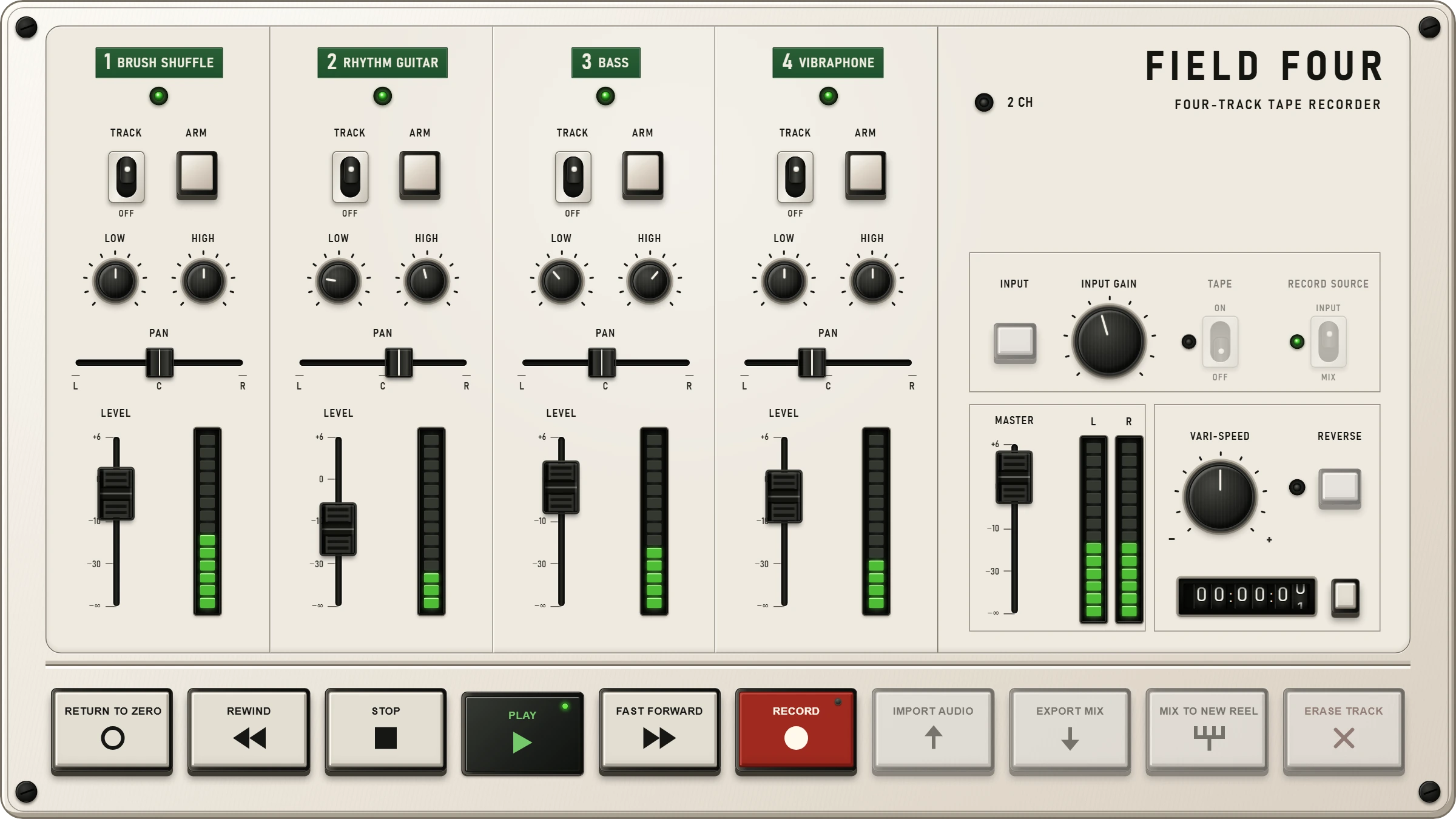
For Field Four, the thing I most wanted to preserve was the tactile and visual experience. Four tracks in front of you and nothing buried in menus. Buttons and switches. The ability to see, touch and move everything immediately.
At the same time, there were limitations that made no sense to keep. I didn’t really want to repeat that experience of “all tracks are full – game over”. So Field Four allows you to mix to a new stereo or mono reel, freeing up two or three tracks to continue working. And I didn’t want to add pointless friction. So, for instance, there is no enforced wait while a faux-tape fake rewinds – “Return to Zero” works immediately.
On creative limitations, I decided to limit myself to things that were actually available on a tape machine. In a digital age, these limitations are arbitrary, but they have historically proved sufficient to create some of the best music of the last hundred years. So there was room for bouncing, mixing, recording to a new reel, and tape-specific effects created by reversing, slowing or speeding the tape. But I resisted the temptation to add “conveniences” like endless effects, drum machines, quantization, or the ability to slide a waveform. If you want those things, they are available elsewhere.
There is a single analogue-style effect in Field Four – the TAPE button. For this, I chose not to replicate the exact audio quality of any particular magnetic tape process. There is no wow or flutter; instead it aims to capture the feel of generationally bouncing and mixing down tape tracks until they acquire that warm saturation. As with real tape, it happens at the moment of recording, and is printed into the take. So, as with real tape, it accumulates with multiple generations. Use it, or don’t – it’s up to you.
I’m not sure how much interest there will be in this. Perhaps you need my very specific set of life circumstances. Maybe you had to be around in the late nineties, during the last gasp of analogue media, turning over tapes to record backwards subliminal messages. Maybe it only makes sense if you had that experience. But for any who do share my particular willingness to embrace the digital, while still maintaining their analogue affections and steady filmic gaze, Field Four is available now in the Microsoft Store, for free.
Download Field Four or visit the Field Four website.
Published .